One Ocean Learn Website
A series of illustrations/GIFs for the One Ocean Learn Platform. The images narrate stories and myths regarding the ocean from different parts of the world. They have been inspired by various locations and cultures related to the oceans, integrating different graphic elements and traditional stories. The illustrations are inspired by the locations and cultures on which this platform is focused.
The images are divided into four themes. Each theme narrates a small story or situation through four iterations of the main illustration in different contexts: day time, night time, good weather and bad weather. The website will geo-locate the viewer and show accordingly to their location.
Theme One: Living Waters
Image 1: People of the river
This image shows the top view of a body of water. In between water layers, we glimpse a mermaid and a snake, reflecting traditions where divine healers are connected to water. These healers hold the belief of ‘living waters’; these waters are home to divinities in many forms.
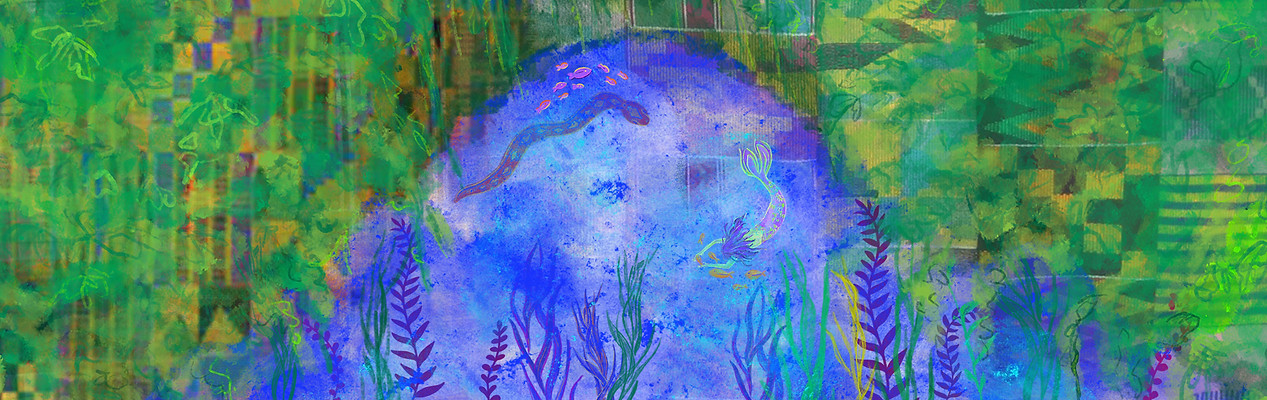


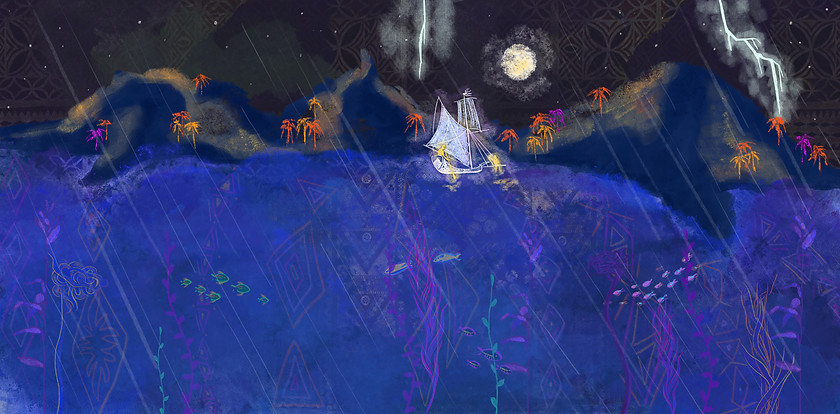
Image 2: Divine healers
In this image, you can see a group of people celebrating a ritual by the sea, while mist falls and lighting is on the horizon. The divine healers host a variety of rituals for their divinities and the ‘living waters’. Rituals include powerful words and song. If the ritual supplication is working, weather changes such as mist, thunder and sheet lightning are expected. Similarly, the presence of birds is used to gauge the pleasure or displeasure of such divinities.
For Namibian Oshtiwambo speaking people (and many communities in Southern Africa), it is believed that the ocean has healing powers. When a person goes to the sea for the first time, they believe that the person has to dip their feet in the water, take a sip of the water and wash their face to avoid okukolwa or sickness.
Image 3: Hawaii’s lantern ceremony
In the interconnected world today, religions and traditions merge and transform in order to create new rituals – this was how the lantern ceremony in Hawaii was born. The Shinnyo-en Buddhist community conceived the ceremony as a way to blend their history with the Hawaiian community and the US American date of Memorial Day. In this event, people write messages to their loved ones on the lanterns and let them drift away at sunset.
Image 4: Hawaiki Island
This image shows an island in the background with a canoe floating, with spirits shining on their way back to Hawaiki. Hawaiki is the mythological origin island of Polynesian people. The stories tell that Polynesians sailed from Hawaiki and arrived at the different Pacific Islands. According to Te Ahukaramū Charles Royal, Hawaiki is the place where the spirits return after death:
Hawaiki as a special place full of mystical power and regenerating force – the source and origin of life itself. Mysterious things happen in Hawaiki: people turn into birds, fish gather in armies, people descend to the underworld and ascend to the heavens. Hawaiki is a paradise where the gods live and perform miraculous deeds.
The Kelp forests are a large ecosystem which provides a safe haven for multiple animal species to coexist, providing food, nurseries and shelter. During strong storms, kelp forests protect the shore line from erosion and filter pollutants. They also help to mitigate Climate change effects by being one of the greatest absorbents of CO2. The illustrations (Images 5-8) depict this rich ecosystem and the different species which inhabit it. Graphic elements from traditional Ghana Kente cloth are included in the representation of the kelp forest.
Theme 2 : Kelp Forests


Theme 3: The legend of Kauila at Punalu’u
The legend tells the story of a magical Honu turtle named Kauila, who hatched at the shore of Punalu’u beach. Kauila would transform into a small girl to play with the children among the Keiki flowers. When she was in her turtle form, the children would know she was sleeping if there were bubbles coming out of the spring on the beach, if not she would keep a watchful eye taking care of the children. The gift Kauila gave to the people of Punalu’u was fresh water, cool mountain water from Mauna Loa percolates through the porous lava. In the past, people would dive to the floor of the bay to collect water. Hence the name of the beach, Punalu’u, means diving spring.
The illustrations of this section narrate the story. The daytime will show Kauila as a girl playing with children at the beach (Image 9). The next day shows Kauila as a turtle sleeping, and the children looking for the bubbles in the spring (image 10). The next night shows the coral reef and underwater ecosystems (Image 11). The final image shows Kauila as a turtle girl sleeping (image 12).
The illustrations are also inspired by the designs of traditional Tapa cloths.


Theme 4 : Sardine run
Each winter in South Africa, millions of sardines arrive on its coastlines. Bringing together fisherman, seals, sharks, seabirds, mothers, dolphins, children; the ocean, wild-life and humans feast together in the bountiful event. The illustrations present this event, both underwater and on land. Depicting the ecosystem and the relations built between ocean life and human kind. The illustrations include patterns and graphic elements of South African graphic and artistic tradition.


